Articles
The Architecture of Terror and the Sociology of the Body
The Dungeons of al-Hajjaj ibn Yusuf al-Thaqafi and the Manufacture of Obedience The Transformation of the Body from a Biological Entity into a Political Can...
The Dungeons of al-Hajjaj ibn Yusuf al-Thaqafi and the Manufacture of Obedience
The Transformation of the Body from a Biological Entity into a Political Canvas
Al-Hajjaj ibn Yusuf al-Thaqafi was not merely a military commander in Umayyad history; he was a social and political engineer who used the “sociology of the body” in the most brutal and ingenious ways to entrench Umayyad rule.
During his tenure, the human body was transformed from a biological entity into a “political canvas” on which al-Hajjaj wrote messages of terror and intimidation for his opponents and society.
The Kufa Sermon: Declaring the Body Permissible for Violation
The sociological relationship between al-Hajjaj and the body began from the moment he arrived in Kufa, in his famous resounding sermon, in which he said:
I can see heads that have ripened and whose harvest is due
From the perspective of political sociology, this speech represents the stripping of the body of its humanity by transforming human heads into “fruits” to be harvested, and the declaration of absolute state ownership over the bodies of the subjects, whereby the ruler alone possesses the right to dismantle them at any time.
Al-Hajjaj’s Dungeons: The Architecture of Torture and Biological Dispossession
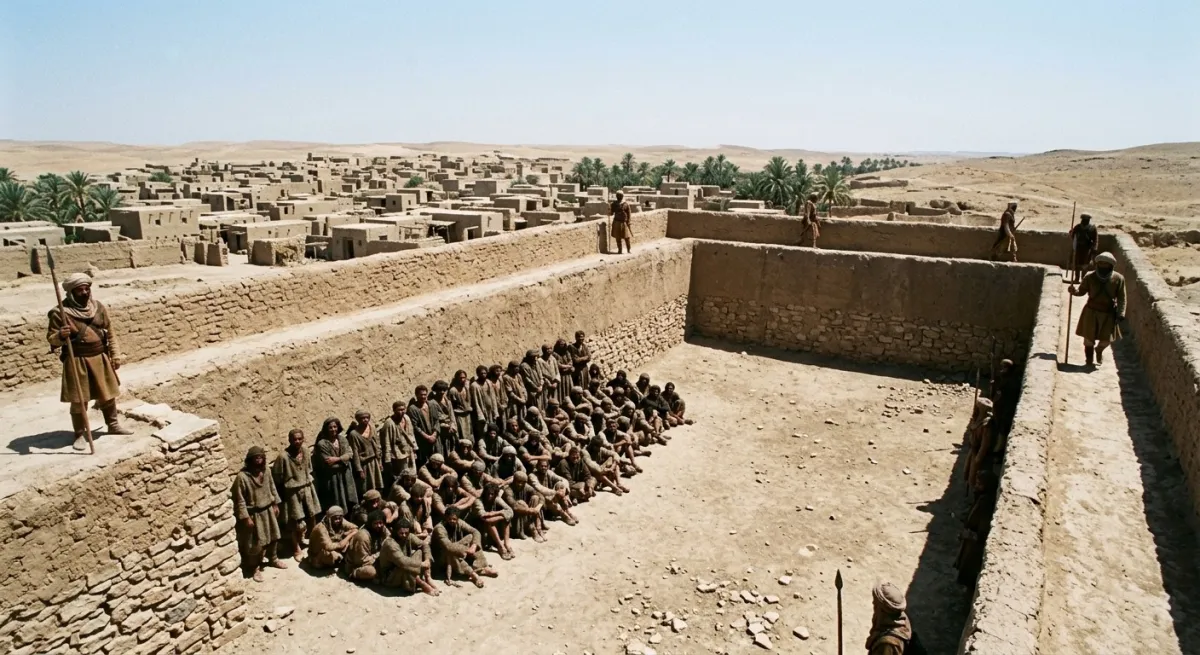
Al-Hajjaj’s prisons—especially the prison of Wasit—were distinguished by an architectural design aimed at socially destroying the body before physically destroying it. This accords with the French philosopher Michel Foucault’s thesis on the “technology of power,” which subjects bodies to surveillance, isolation, and abuse. This was manifested in two mechanisms:
First: Roofless Prisons and the Torment of Nature:
Al-Hajjaj left prisoners under the blazing sun and in the bitter cold. Sociologically, this deprived the body of privacy and stability and turned it into a body exposed to nature in order to break the pride of the human spirit, as Ibn al-Athir relates:
“Al-Hajjaj built a prison in Wasit with no roof to protect people from the heat and cold. When it rained, they stood in mud up to their knees, and when it was hot, they could find no shade.”
Second: Crowding and the Erasure of Individual Identity:
By eliminating personal space between bodies, the people inside the dungeon became a single biological mass devoid of individual identity. This altered their outward features to such an extent that mothers were unable to recognize their children.
Public Torture: The Body as a Spectacle
According to modern sociological theories, punishment in the Middle Ages was not intended to reform the prisoner, but to terrorize the spectators.
Al-Hajjaj used the bodies of his opponents as tools of political communication through crucifixion and the amputation of limbs in public spaces—not to punish the individual himself, but to send a terrifying visual message to anyone considering rebellion.
Strategies of Resistance: The Steadfastness of Defiant Bodies
The sociological paradox becomes evident when the machinery of military terror fails before the steadfastness of the victims’ bodies and their defiant language, as pain is transformed from a punishment into a means of symbolic victory:
Sa'id ibn Jubayr: The Smile That Shook Authority
Sa'id ibn Jubayr’s steadfastness and smile represented a genuine shock to al-Hajjaj, because the steadfastness of the victim’s body meant the failure of the authority’s technology of terror and the triumph of the spirit and conviction over the military machine:
When Sa'id ibn Jubayr was brought before al-Hajjaj, al-Hajjaj said to him: “What is your name?” He replied: “Sa'id ibn Jubayr.” He said: “Rather, you are Wretched son of a Broken one!” He replied: “My mother knew my name better than you.” When al-Hajjaj ordered him to be slaughtered, Sa'id laughed. Al-Hajjaj said: “What makes you laugh?” He replied: “I am astonished at your audacity toward God and at God’s forbearance toward you.”
Kumayl ibn Ziyad al-Nakha'i: The Language of the Calm Body
Kumayl was one of Imam Ali ibn Abi Talib’s companions. Al-Hajjaj pursued him for years until Kumayl surrendered himself in order to spare his people harm. When he entered upon al-Hajjaj, al-Hajjaj sought to break his pride by threatening him with immediate death. Kumayl confronted him with an entirely calm body language and words that stripped authority of its symbolic power, saying:
“Do not bare your fangs at me or flash your eyes; by God, nothing remains of my life but the equivalent of dust clouds. So carry out whatever you are going to carry out, for the appointment is with God, and after the killing comes the reckoning.” Then al-Hajjaj ordered his neck to be struck, and he died steadfast.
The Fall of the Legitimacy of Violence Even Amid Its Practice
The dungeons of al-Hajjaj ibn Yusuf al-Thaqafi and his repressive policy were not merely expressions of personal sadism; they were an “organized sociological mechanism” for producing a submissive society through terrorizing and exhausting the body.
Al-Hajjaj’s experience demonstrated that despotic authority views the human body as the primary field that must first be controlled in order to ensure control over minds and countries later.
Yet the steadfastness of the bodies of thinkers and scholars such as Sa'id ibn Jubayr and Kumayl ibn Ziyad historically proved that authority may control enclosed spaces and the physical body, but is utterly incapable of imprisoning conviction and meaning.
From the perspective of contemporary philosophy of law and personal rights, what al-Hajjaj’s despotic machinery perpetrated inside the prisons of Wasit constitutes a stark historical condemnation of the violation of fundamental human rights.
The human body possesses natural and personal rights inherent to its humanity—rights proclaimed by spiritual values and codified in modern international covenants—foremost among them the right to bodily integrity, the right to psychological integrity (which al-Hajjaj violated through torture and public crucifixion), the right to dignity and privacy, and the protection of personal identity from erasure and destruction (which was shattered by the design of roofless open prisons and the biological crowding of human beings).
Sources and References
1) Ibn al-Athir, Izz al-Din (1965) — Al-Kamil fi al-Tarikh (edited by Dr. Kamal Marwa, 1st ed., vol. 4, Events of the Year 82 AH, pp. 471–472), Beirut: Dar Sader.
2) Ibn Kathir, Imad al-Din (1998) — Al-Bidaya wa al-Nihaya (edited by Abdullah al-Turki, 1st ed., vol. 11, pp. 300–312), Giza: Dar Hجر for Printing and Publishing.
3) al-Dhahabi, Shams al-Din (1985) — Siyar A'lam al-Nubala' (edited by Shu'ayb al-Arna'ut, vol. 4, pp. 118–119), Beirut: Al-Resalah Foundation.
4) Foucault, Michel (2014) — Discipline and Punish: The Birth of the Prison (translated by Ali Muqallad, 2nd ed., pp. 45–50), Beirut: National Development Center.
5) Le Breton, David (1997) — Sociology of the Body (translated by Adel Bensr, 1st ed.), Casablanca: Toubkal Publishing House.
Hesham Elbanna
Researcher
No comments yet
You must sign in to comment. Sign in
No comments yet. Be the first to comment.